The best science is done collaboratively. Astronomers need a wide range of skills and expertise to study the fascinating phenomena we find in the Universe, and this usually means teams of specialised and talented people working together. I am lucky to be a member of a number of pioneering and dynamic transient hunting collaborations and consortia.
STARGATE

Credit: European Southern Observatory (ESO)
STARGATE is a European collaboration of astronomers dedicated to following up gamma-ray bursts (GRBs) with the Very Large Telescope at Paranal Observatory in Chile. The VLT actually consists of 4 “unit telescopes.” Each of them has a primary mirror with a diameter of over 8 metres, making them some of the largest telescopes in the world. This makes them ideal for chasing GRB afterglows as they rapidly fade, or taking spectroscopic observations to measure the redshift of a GRB’s host galaxy to learn how far away it is. The most distant GRB ever recorded had a redshift of 8.2, which means it exploded 13 billion years ago, when the Universe was only 600 million years old. STARGATE is capitalised because it’s an acronym (based on the TV show of the same name), but no-one can really remember what it stands for. The “G” probably stands for GRB…
ENGRAVE
ENGRAVE is also a European collaboration of astronomers who use the VLT to chase transients, but this time the target is gravitational wave (GW) events. These ‘ripples in space-time’ are caused by the mergers of compact objects like neutron stars and black holes – exactly the same type of events that produce GRBs. Since the first detection of GWs in 2015, astronomers have detected lots of ripples, but only once have we been able to find the electromagnetic (EM) counterpart: GRB 170817A and the kilonova AT2017gfo, which were both found following the neutron star merger event GW170817. This historic discovery marked the beginning of the era of GW-EM multi-messenger astronomy, and ENGRAVE is poised to chase down the next landmark event.

Credit: N. Tanvir / A. Levan / ESO
GOTO
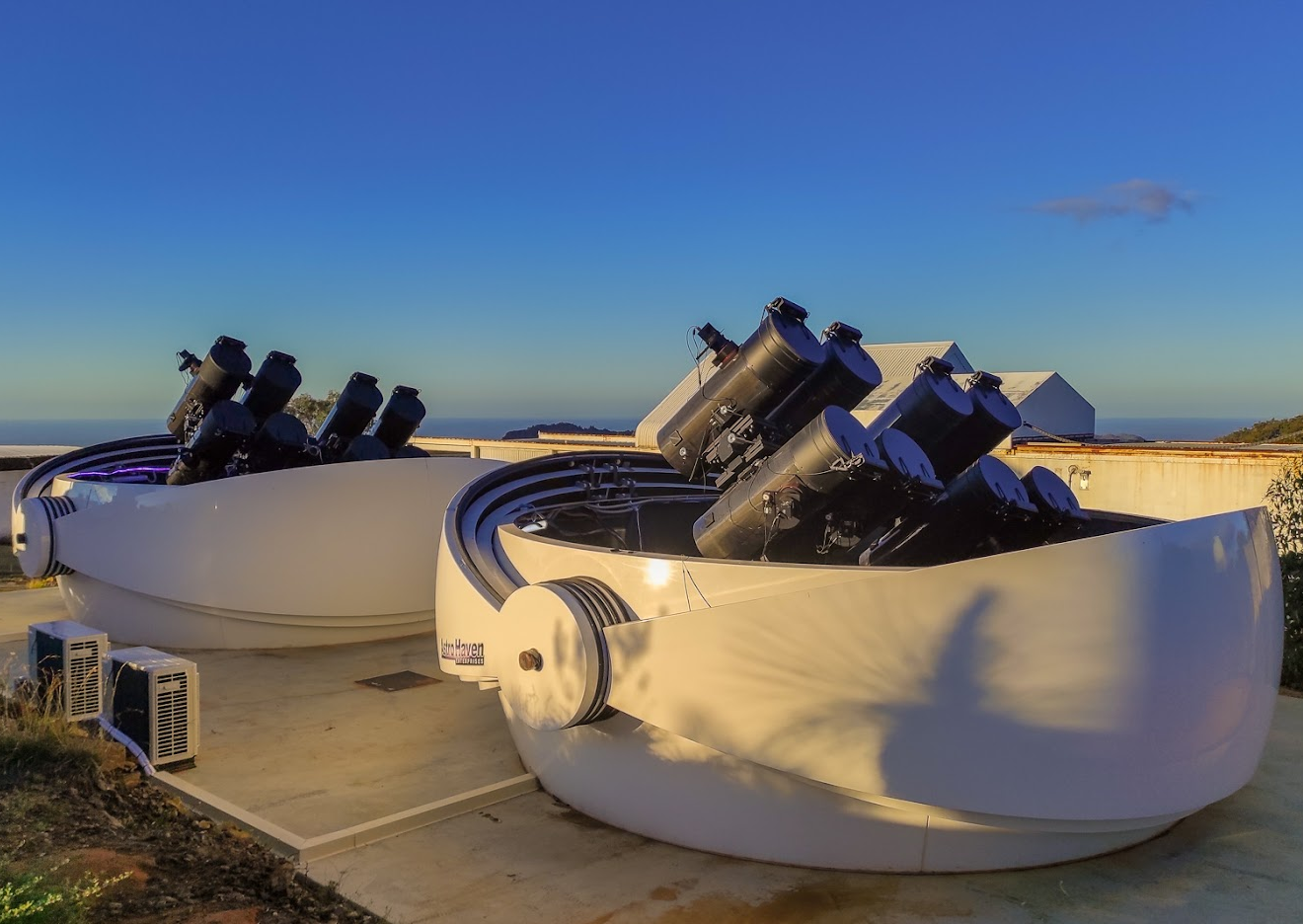
Credit: Krzysztof Ulaczyk
The Gravitational-wave Optical Transient Observer (GOTO) is a network of telescopes situated at Roque de los Muchachos Observatory on the island of La Palma, Spain, and Siding Spring Observatory in Australia. GOTO is a wide-field search and survey telescope designed to rapidly respond to GW alerts and search through wide areas of the sky to locate their optical counterparts. It also responds to alerts from GRB-hunting satellites, and performs a survey of the full sky once every three days. I am the coordinator of the GRB working group in GOTO, where I lead an international team of astronomers searching for GRB afterglows following the high-energy gamma-ray signatures.
Rubin LSST
I am a UK Affiliate PI for LSST:UK, one of the largest international contributors to the Vera C. Rubin Observatory‘s Legacy Survey of Space and Time (LSST) project. Rubin is a next-generation wide field facility with an 8-metre diameter primary mirror that can cover almost 10 square degrees in a single pointing. It is expected to achieve 90% completeness for kilonovae out to 200 Mpc. The telescope is due to begin science operations in 2025, when it will survey the entire sky every 2 – 3 night to unprecedented depths.

Credit: Rubin Observatory
Others
I am a member of the Advanced Telescope for High Energy Astrophysics (ATHENA) collaboration. Now styled “NewAthena,” it is a general-purpose open X-ray observatory that was selected for launch in 2037 as part of the European Space Agency’s Cosmic Visions Programme in 2014. I serve on Science Working Group 2.6, which focuses on luminous extragalactic transients.
I am also a member of the THESEUS consortium. THESEUS is a European Space Agency M-class GRB mission concept being proposed for launch in 2037.
 Dr Benjamin Gompertz